

Description: This article reviews the regulatory tools and tactics that the City of San Diego has used to exert greater control over our coast. It documents the city’s use of fear to manipulate the public into giving up their liberties and rights. The good news is that the people and the courts are pushing back on the city’s monopolization and monetization of our public spaces.
Paid parking at Balboa Park. Beach and bay bathroom closures. The war on fire rings. The beach yoga ban.
Nothing is sacred anymore. Nothing’s off the table. Every inch of public space, and increasingly the coast, can be micro-managed, regulated, and monetized by the city government.
Looking at it from the 10,000-foot level, a pattern over the last two decades becomes clear. The city has been over-regulating, sanitizing, gentrifying, and monetizing our coast, especially our beaches and bays. Its myriad ordinances exerting control over our shared space represent an erosion of our most fundamental liberties. The good news, as we’ll see, is that the people are fighting back – and they are winning
I use the word “erosion,” because we didn’t lose our liberties overnight. It happened gradually through a series of incremental ordinances passed by successive city councils and mayors—driven in large part by resident complaints and property owner lobbying.
Let’s start our journey with the beach booze ban.
A riot in Pacific Beach in 2007, in which alcohol was said to play a role, required 70 police officers in riot gear to disperse the crowd. It was all over the San Diego news. The next year, voters approved Proposition D, banning alcohol from San Diego city beaches.
Fast-forward to 2026.
You’ll see cops and lifeguards at Pacific and Mission Beach cruising around in their trucks or ATVs, watching me, watching you. It feels like the militarization of our public spaces.
This summer, according to SDPD data, police officers issued more than 1,380 beach booze citations.
Beach Fire Rings
The city has repeatedly tried to ban beach fire rings, claiming it couldn’t afford them because of the budget deficit, or arguing that beach fires are bad for air quality and pose a danger when hot coals are left in the sand.
In 2008 and 2010, community opposition and foundation support saved the rings. The city did, however, succeed in banning the burning of pallets on the beach and in imposing a curfew for beach fires.
Looking back, 2008 was a pivotal year in the city’s War on Beaches. With one hand they banned alcohol on the beach, while with the other they tried to ban beach fire rings.
Fast-forward to 2025-2026 budget negotiations. Mayor Gloria tried to save $135K annually by getting rid of all 184 fire rings. The savings would have come from reducing maintenance and staff hours. The California Coastal Commission opposed it, as did many San Diegans.
This past summer, there were 16 fewer rings than in 2025. And, the eight fire rings at South Mission Beach were permanently removed.
Boardwalk Vendors
Between 2014 and 2018, the city introduced new regulations on vendors, food trucks, and street performers along beach boardwalks.
In 2024, even stricter regulations were imposed by the city, seeking to ban most commercial vending from the boardwalks entirely and allowing the city to seize and impound vendor carts.
The courts intervened, ruling that the city had violated state law, SB 946, which had decriminalized vending. Gloria and the City Council have since gone back to the drawing board and are expected to vote on a revised ordinance by late fall.
There may be no better illustration of how our coast has become over-regulated and over-sanitized than San Diego’s crackdown on beach yoga.
The War on Yoga can be traced back to 2024, when the street-vending ordinance was making its way through the City Council. The council quietly added a rule banning group fitness and yoga classes of four or more people at all coastal parks and beaches.
Rather than view the yoga enthusiasts as an inspiring expression of health and humanity, the city shut them down. It claimed that the free and donation-based morning classes at Sunset Cliffs and Palisades Park in Pacific Beach are commercial enterprises – and also a public nuisance.
Per the new ordinance, Yoga instructors need to get commercial permits and pay a bunch of fees…or face the wrath of the park rangers which, like hyper-empowered hall monitors, issued hundreds of dollars in citations to local instructors. One was Steven Hubbard, AKA, “NamaSteve,” who was ticketed for live-streaming a class from the beach. Another time, when he was live-streaming from his backyard, park rangers tracked him down to his home, ala ICE, and handed him a citation. Can you say creepy!
I don’t know what is more ridiculous, the City of San Diego’s War on Yoga or Del Mar’s War on Sandcastle Builders. While kids can still build sandcastles at Del Mar beaches, they’re not allowed to build holes in the sand deeper than two feet. Every single hole, regardless of how small, must be filled back in before leaving the beach. Also, the city made it illegal for a child to playfully bury his sibling in the sand. That is now a strict no-no. Parents are held legally responsible if their children break any of the rules. After an initial warning, a $100 fine.
Then there’s the city’s War on Beach Volleyball. In April 2026, in response to noise complaints from people staying at short-term rentals, the City of San Diego tried to shut down early-morning beach volleyball at South Mission Beach. The volleyball players have careers and families – starting early is the only way they can fit it into their schedules. And they policed themselves, taking precautions, like not playing music until 9 a.m. Still, park rangers were sent to South Mission to confront the unsuspecting volleyball players. The message was clear: If they started playing earlier than 8 a.m., they’d be fined.
War on the Restrooms
Those same volleyball players, if they needed a restroom break back in July, would have had nowhere to go, because the city closed 13 beach and bay restrooms. The number crunchers at the city estimated that the closures would save $550,000 annually towards closing the $100 million deficit. As Richard Bailey pointed out at the time, the city spent $6 million to rebuild two Mission Bay Park restrooms that were now closed. Bailey, the former mayor of Coronado who’s running for City Council in District 2, said, “As bad as the restroom closures are, the bigger question is why is the city spending millions to build new facilities when it can’t afford to keep existing facilities open…from the OB Pier to the Mission Beach Lifeguard Tower to these Mission Bay Park restrooms, the city has a pattern of letting facilities fall into a state of disrepair.”
Developing the Coast
The city has sought to increase density near coastal transit lines and pave the way for more coastal development by expediting the permit process and weakening environmental review. The Surfrider Foundation said, “Developers, state legislators, and the Trump administration keep pushing to weaken hard-fought environmental and access protections.”
Midway Rising’s 165-foot-tall structure exceeded the voter-approved, 30-foot height limit for buildings in the coastal area. Gridlock along Midway and the 5, and flooding, were also concerns. The city tried twice — in 2020 and 2022 — to bypass the height limit with ballot measures. Although narrowly approved by the voters, the courts invalidated both. Meanwhile, the developer refused to scale the project down to 30 feet.
They wanted the whole enchilada or nothing at all, and they got it.
Last month, state lawmakers intervened, passing Senate Bill 958 and 344, which would expedite construction of a 25-story professional arena, 4,250 housing units, and over ten acres of public parks. The fact that state legislators that are unaccountable to San Diego voters were the final deciders is hard to swallow.
Governor Newsom has until Sept. 30th to sign the bill. The city and Midway Rising developers must come to an agreement by Dec. 4.
The Vela development, AKA, the Turquoise Tower, is a 23-story, 239-foot, high-end tower that could be built on Turquoise Street in Pacific Beach.
If developer Kalonymus receives the green light from Mayor Gloria, the development, which exceeds voter-enacted height limits, would fundamentally alter this quiet section of north PB.
Dr. Marcella Bothwell, founder of Neighbors for a Better California, told S-REPORTER: “We can have affordable housing AND protect our environment and quality of life…It doesn’t mean that we have to destroy the coastal communities, eliminate safety standards and wreck environmental protection laws to create affordable housing.”
While it appears that Midway Rising is moving, inexorably, forward, Mayor Gloria’s in a position to deny the permit for the Turquoise Tower in north Pacific Beach, and I hope that’s what he does.
A Third Place
When the city introduced paid parking at Balboa Park, it was accused of monetizing San Diego’s commons and diminishing public access. The people’s park was no longer for all San Diegans. Whether at the beach or park, paid parking discriminates against working-class families who rely on coastal beaches and parks for low-cost fun.
Bob Kelly, the former president and CEO of the San Diego Foundation, underscored the importance of maintaining our public spaces for the enjoyment of the people, noting that “people with little income can go out and enjoy the beach.” That’s also the view of the California Coastal Commission—shutting down restrooms and charging for parking diminishes public access to the coast.
Our beaches used to be viewed as a democratic, affordable “third place”—a public space outside of home and work where people could hang out and socialize without breaking the bank at a bar or restaurant. Access means that beaches remain open to all income levels, rather than turn into orderly, gated backyards for coastal property owners.
Because of the city’s over-regulation of our public spaces, it’s hard these days to find a third place that’s truly for the people.
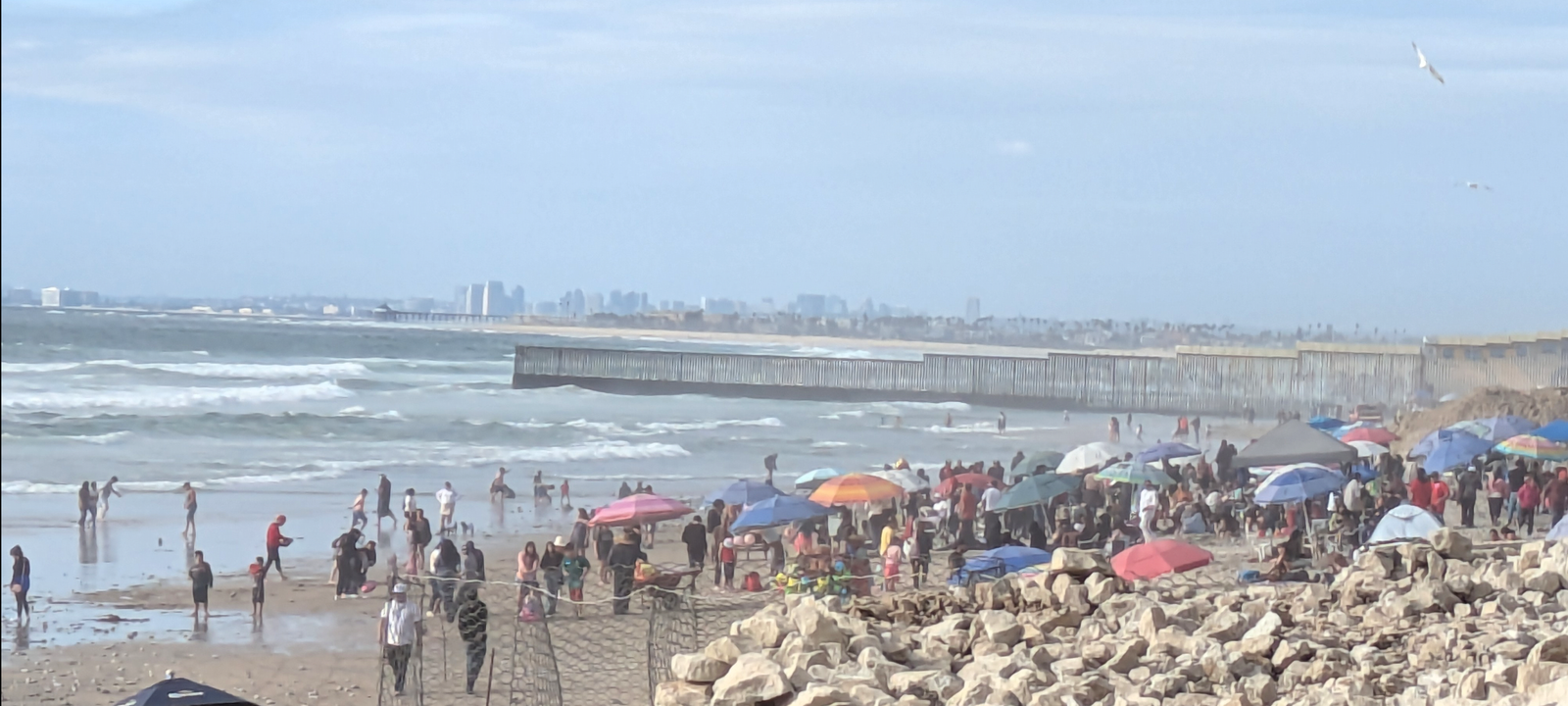
As a point of contrast, there’s Playas de Tijuana, on the other side of the border wall…but culturally worlds apart.
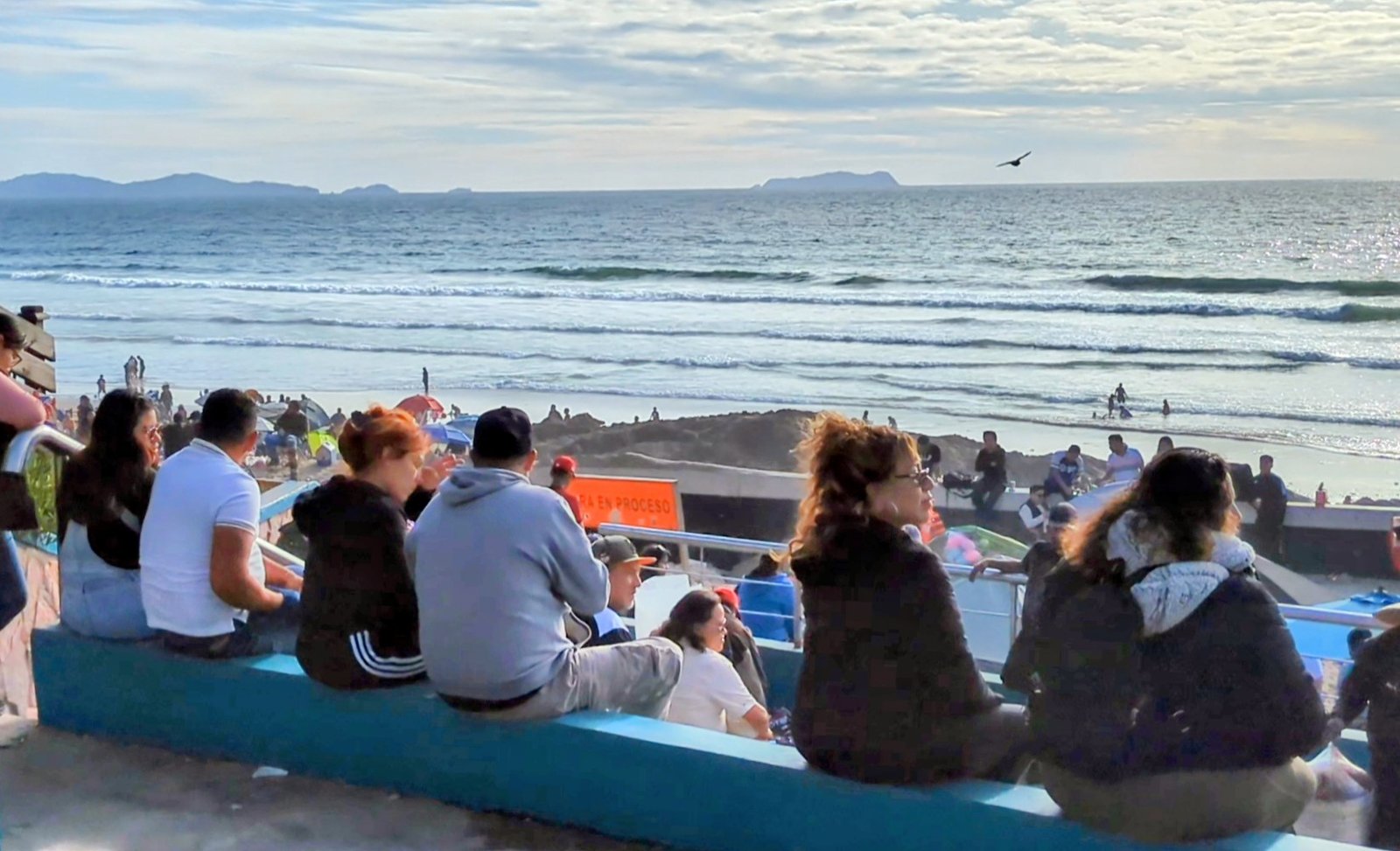
There you will see the malecon, or boardwalk, brimming with activity: multi-generational families strolling, young lovers holding hands, men drinking Tecate along the beach wall, along with vendors, street performers, music and entertainment, restaurants and bars. The police are barely visible, around but not in your face. The people largely police themselves; community norms shape how they behave in public, and rarely are there disturbances.
Different cultures have different relationships with public space and with alcohol. In Mexico, alcohol consumption is a part of normal social life rather than being seen as a threat to children.

In Playas de Tijuana, the beach functions as an economic and social common square featuring families, vendors, musicians, and restaurants sharing the same space. The vendors are not viewed by the restaurants as competition but as part of the same ecosystem. It’s a more organic freedom than we have north of the border, where we are constantly being watched by police, lifeguards, park rangers…and cameras.
How did we get here?
My take: All the constant fear-mongering you see on the local news has made us a more fearful community. Even when the crime rate drops, fear is baked into us by the culture—specifically, by local TV news. Fear of outsiders, fear of the pedo who could be our next-door neighbor, fear of “those people” that want to harm us, fear of homeless people, trouble makers, the riff raff.
As the San Diego Union-Tribune noted, the campaign in 2008 that convinced voters to approve the beach booze ban employed fear to scare San Diegans. The beaches are being taken over by the riff-raff! Anarchy at the beach! When people are afraid, they’re more willing to give up their liberties.
Coastal homeowners are the other factor driving over-regulation of the coast. Paying millions to live by the beach, they want their environs safe, secure, orderly, clean, and quiet. Community groups and town councils advocate for homeowners and have significant clout at City Hall.
When the City becomes an HOA
Essentially, the city has become an HOA for wealthy coastal homeowners who want their litany of complaints heard and acted on. Once primarily comprised of blue-collar folks, the coast has become increasingly gentrified over the last 40 years. Coastal cities often use secondary rules—like early park closure hours, removing fire rings, blocking parking lots, or closing public restrooms—to discourage non-residents from hanging out and making noise that might disturb residents.
I may be in the minority but I don’t believe the government should interfere with public spaces and organic life unless there’s an immediate and significant threat to public safety. An example would be the E-bike ban at Mission and Pacific Beach. Reasonable regulation, yes – but mostly what I see is over-regulation, where the city responds to practically every complaint by rolling out a new ordinance.
Whether the city is banning yoga from coastal parks, banning beer on the beach, banning beach fire rings or boardwalk vendors—make no mistake, banning is an authoritarian instinct. Banning says to the people that they’re not worthy of liberty. It says the government does not trust the people to regulate their own behavior. Big government must step in.
Not all bans are bad, of course. It just depends on how much freedom we’re willing to surrender.
Clearly, our local government’s impulse to exert control over – and monetize – our shared public spaces must be reined in. The good news is that the people are fighting back and, more often than not, winning.
For example:
Beach Fire Rings Rebound. From 2008 to 2025, the city tried to remove beach and bay fire rings. Public opposition, and a warning from the California Coastal Commission, saved San Diego’s longtime beach tradition. The city was forced to find an alternative funding mechanism – the general fund – to pay for fire ring maintenance, bringing an end to the war on beach parties.
The end to paid parking at Balboa Park. Following public backlash together with a 33 percent drop in museum attendance, the San Diego City Council reversed course – all paid parking will be removed by Jan. 1, 2027.
A pre-emptive strike against paid parking at city beaches and bays. City Councilmembers Joe LaCava and Raul Campillo recently introduced an ordinance that would keep beach parking free for the next ten years. It’s a recognition that the coast belongs to the people – all the people – and must not be used as an ATM to close budget deficits. Unfortunately, in August, it was amended in committee at the urging of Councilmembers Sean Elo-Rivera and Kent Lee. The free-parking guarantee was made permanent, but only for San Diego residents. That could be problematic with the California Coastal Commission, which generally prohibits charging different parking rates based on a visitor’s place of residence. The full San Diego City Council is expected to vote on the free beach parking ordinance sometime in October.
Restrooms rest their case. The directive to close public restrooms at Mission Bay and city beaches came in July, at the start of a new budget year. It didn’t go over too well, to say the least. Homeowners complained that beachgoers were using “their” streets, alleys, and front lawns as public toilets. Following public outcry, in mid-August, the city again reversed course, re-opening 13 public restrooms.
It’s important to note that Mayor Gloria backtracked on the restrooms not out of principle but because coastal homeowners and neighborhood groups like the Pacific Beach Town Council opposed the closures. Feeling the pressure, the city found the money in the budget—well, at least for now. The 13 restrooms are only funded through Dec. 31, 2026.
The aforementioned war on beach volleyball is over. After they were ticketed by park rangers and told there will be no early-morning beach volleyball, the South Mission Beach volleyball players fought back, on a couple different fronts. They launched a petition on Change.org that quickly got around 3,000 signatures; meanwhile, players met with Parks and Recreation officials and lobbied Mayor Gloria. The city was forced to change course, siding with the San Diego locals over the out-of-town complainers. To accommodate the players, the city moved the earliest start time from 8:00 a.m. to 6:00 a.m., not just at South Mission but at beach volleyball courts across the city.
And, another partial victory – the courts intervened in the city’s war on yoga. In Hubbard v. City of San Diego, the Ninth Circuit Court of Appeals held that banning yoga classes conducted on public space violated the First Amendment. “The court finds the issuance of citations for lecturing in a park and teaching online from one’s home to be obviously unconstitutional,” wrote Judge Bencivengo. In other words, the government shouldn’t be in the business of regulating expressive activities like teaching yoga.
But the city is having trouble accepting defeat. In fact, the city went to court arguing that, because Hubbard receives tips, his classes are a commercial enterprise and can be regulated. Only months after the court’s decision, park rangers detained Hubbard at Palisades Park, issuing criminal citations for “unpermitted commercial activity.”
To prove Hubbard operates a commercial business, the city issued 22 subpoenas targeting Hubbard’s bank records, Venmo accounts, social media platforms, and even the GPS coordinates of students who donated. Hubbard’s attorney called that tact “harassment,” and has made a motion to have the subpoenas quashed. The judge will rule on the case in Jan. 2027.
Until these issues are resolved by the courts, park rangers are free to hand out citations to unsuspecting yoga teachers. Be careful out there!
This year is, coincidentally, the 50th anniversary of the California Coastal Act, the landmark law mandating protection of the coastal environment while maximizing public access. It is good to see San Diegans reclaiming their public spaces and taking them back from the government.
As the Surfrider Foundation said, the Act “enshrines our right to enjoy California’s ocean, waves, and beaches.”
Who knows, maybe one day we’ll be able to enjoy a beer on the beach without being ticketed.
But I’m not holding my breath.
Editor’s Note: Read “Mayor Gloria to take helm at U.S. Conference of Mayors”
Prefer to listen? Our podcast episode on San Diego policy and oversight discusses the beach booze ban.
Thank you for supporting S-REPORTER, your hyper-local and independent source for San Diego news.








Leave a Reply