

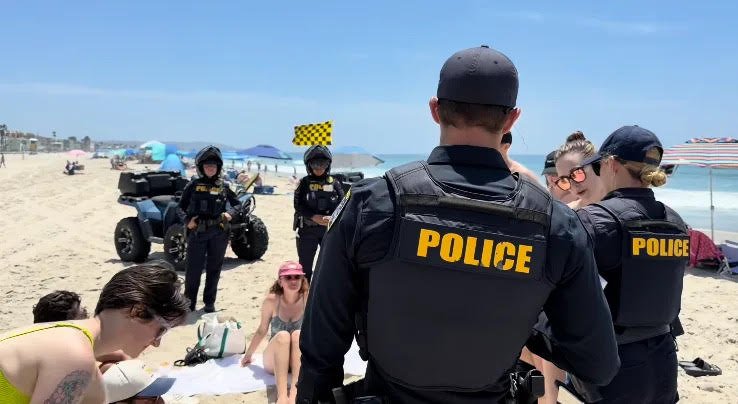
This summer, police officers have issued more than 1,380 beach booze citations, according to data provided by SDPD.
Sometimes they start by “educating” the beachgoers, that is, giving them a warning, but it’s up to the discretion of the officer. First offense carries a minimum $250 fine; repeat offenses can bump it up to $1,000 fine and up to six months in jail.
You’ll see cops and lifeguards at hot spots like Pacific and Mission Beach cruising around in their trucks or ATVs, watching me, watching you. It may feel like they’re militarizing the beach, just like SDPD militarizes certain neighborhoods in San Diego.
How did we get here?
The city began criminalizing beachgoers in 2008 after an “alcohol-fueled” riot in Pacific Beach that required 70 police officers in riot gear to disperse the crowd. Some spectators claimed it was out-of-towners, not the locals, that started throwing beer bottles at the cops. At any rate, the city enacted a beach booze ban, which was intended to be a one-year trial. However, six months into it, the eager-beaver city council voted unanimously to put a measure on the ballot banning alcohol from San Diego city beaches. Voters approved the measure, known as Proposition D, on November 4, 2008, by a slim margin (54%). The law also banned open alcohol containers in adjacent public spaces, including boardwalks, sidewalks, piers, and parking lots.
As the San Diego Union-Tribune noted in a 2008 article, the election data revealed an interesting geographical divide. Coastal communities most impacted by the rules (including Pacific Beach, Mission Beach, and Ocean Beach) actually voted against the ban, while inland communities tended to support Proposition D.
The 2008 ban only applied to land. In 2009 and early 2010, according to San Diego news reports, thousands of people organized massive “Floatopia” parties, where they enjoyed alcoholic beverages while floating just a few feet offshore on rafts, inner tubes, and surfboards. The City Council closed this loophole in 2010 by extending the beach booze ban to three miles offshore.
San Diego is not alone. Across the state and country, most coastal cities prohibit alcohol consumption on the beach. Interestingly, Del Mar is the only city in San Diego County where you can drink alcohol on the beach, but only after the tourists have gone home: after Labor Day until the day before Memorial Day. During the peak summer months, alcohol is banned on Del Mar beaches. At state camping grounds like San Elijo State Beach, you can enjoy an alcoholic beverage at your campsite.
Turning the clock back to 2008, it appears San Diego was in the thralls of a moral panic. Footage of the PB riot left an indelible mark on many San Diegans. Barbara O’Connor, a California State University-Sacramento professor, told the San Diego Union Tribune: “Nobody wants to say they are relying on fear appeals to win. That would be insulting, but they do.” When the people feel fearful, they’re more willing to give up their freedoms.
Still today, many San Diegans feel that a single, highly publicized event was used to strip away liberties from law-abiding citizens. Prior to the beach booze ban, the vast majority of police citations were for public intoxication, underage drinking, littering, and noise violations, minor infractions that, some feel, didn’t justify a total revocation of public property rights. In retrospect, was punishing the majority of responsible beachgoers for the actions of a few a disproportionate response?
Editor’s Note: Read “Beach Bar Attacks Expose San Diego’s Dark Underbelly.”
Thanks for supporting S-REPORTER, your independent and local San Diego news source.





Leave a Reply