
Back Story
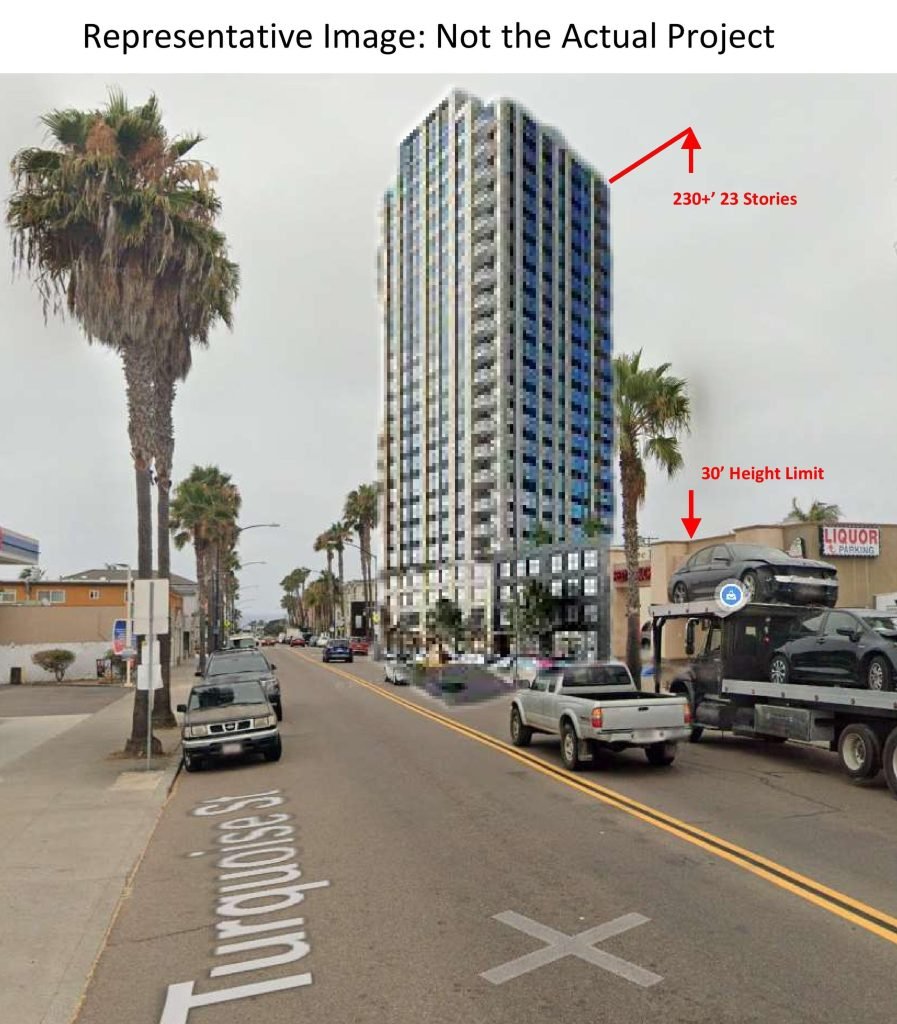
Los Angeles developer Kalonymus LLC is seeking to build a 23-story, mixed-use high-rise blocks from the beach in north Pacific Beach. The Project Vela development at 970 Turquoise Street, which takes advantage of state density bonus laws, is extremely troublesome because it violates a voter-enacted law that limits building heights to 30 feet or less in the coastal area.
Even more disturbing: California’s Department of Housing and Community Development cavalierly dismissed the 1972 voter initiative that set the height limit, declaring that the state law trumps the will of the people – the will of San Diegans – to protect their greatest asset, the coastline.
Why Project Vela, in its current iteration, should be opposed
1. It’s an abuse of state density bonus law.
Developers exist to make profit and, with the exception of nonprofit builders, aren’t in the affordable housing business. If we want more affordable housing, either we taxpayers must subsidize the developers as is being done with Rose Creek Village, also in PB, or we incentivize them to build affordable units. State density bonus laws are designed for the latter: If you, Mr. Developer, allocate some units for lower income tenants (where they lose money), we’ll make it up to you by allowing you to build more market rate units (where they make the real money) – and possibly build higher – than what the zoning dictates.
But in practice, this tradeoff is, in many cases, fundamentally flawed and patently unfair.
Exhibit A: 970 Turquoise Street.
“It’s just an enormous money grab,” says Marcella Bothwell, chairwoman of the Pacific Beach Planning Group. “I think it’s an embarrassment for these state legislators, because this is such a flagrant abuse of a state law which was well intended.” In a letter she sent to the state’s Department of Housing and Community Development, California state Sen. Catherine Blakespear referred to the development as an “inappropriate use of the state’s housing laws.”
Clearly, the developer is pushing the density bonus envelope, and can be forgiven for trying – we live in a capitalist system, after all. Says Bothwell: “I mean, if I were going to pick a spot that was going to have bay and ocean views, I would pick Turquoise. I mean, it’s ideal. If you’re a developer and you put up 23 stories, you’re going to make a lot of money. They picked an ideal spot. It’s just they don’t care about the community at all.”
It seems our legislators in Sacramento handed a generous gift to their developer donor friends and sold it to us as progressive social policy. Or, more charitably, they had good intentions that were exploited and thwarted by predatory developers. (Which one is it? Share your thoughts below.)
I should point out that there are attorneys and consultants who boast about their ability to help their clients exploit density bonus legislation. “The value of a lawyer in any kind of land use project is to find out how to legally avoid the restrictions and to capitalize on what the statutes and ordinances allow,” writes Stephen A. Jamieson, an attorney at Solomon Saltsman & Jamieson in Los Angeles. “If you look at the face of the zoning code and don’t see things like the density bonus law, you’re going to miss out on important opportunities—not just to develop a particular piece of land, but to do so incredibly profitably and to massively decrease the amount of time, effort, and challenges it normally takes.”
Clearly, the system encourages and rewards predatory behavior. It’s not the developer’s job to care about our quality of life or to lose sleep over what’s fair – that’s our job. It’s up to us to push back. That’s what Marcella Bothwell’s Neighbors for a Better California and Scott Chipman’s San Diegans for Responsible Planning are doing.
For his part, Mayor Gloria, who also opposes the development, says there are loopholes in the state density bonus laws and that he intends to work with Sacramento legislators to close them.
What those loopholes are, he did not specify.
2. As a charter city, San Diego should have the final say about height limits.
The home rule doctrine – it’s right there in Article XI, section 5 of the California Constitution. And it gives charter cities, which San Diego has been since 1931, the power and autonomy to make and enforce their own laws and ordinances. (San Diego is one of 108 charter cities in the state. The other 370 cities that haven’t adopted a charter are general law cities bound by state law.)
Constitutionally, Sacramento must defer to charter cities, except where a uniform policy throughout the state is needed, such as traffic and vehicle regulation, or a statewide emergency.
While California is undoubtedly an expensive state in which to live, there’s no one-size-fits-all solution to the housing affordability crisis. Bakersfield is different from San Diego which is different from Anaheim. It may be a political emergency in the eyes of our ambitious governor, but politics doesn’t justify the state intruding into the affairs of a charter city and negating the will of the people by overriding a local law.
And to be clear, securing five to ten affordable units in an elite 23-story tower overlooking the Pacific Ocean does not advance or achieve a meaningful state interest.
“If you just let developers throw up high rises and make tons of money, that kind of means you really didn’t care about the statewide emergency in the first place,” says Bothwell.
If it’s truly a statewide emergency that warrants overriding the will of San Diego voters, then give me 75 affordable units, even 50, and I’m on board. But five? Crumbs.
And then the question becomes, is it worth it to disrupt and potentially destroy Pacific Beach in exchange for said crumbs?
Is it worth giving developers so much in return for so little?
3. It’s the wrong kind of housing
Project Vela is a “predominantly non-housing development,” says Bothwell, given that the proposal calls for 139 hotel rooms, which the zoning allows for. Hotel rooms are not housing. Hotel rooms do not advance the intent of the state bonus density laws. (It’s been reported that the developer plans to convert the hotel rooms into market-rate apartments.)
At least Rose Creek Village, another controversial development in Pacific Beach that also exceeded the coastal height limit, “was 60 units of actual affordable housing.” The 23-story Project Vela, on the other hand, “will have a penthouse on the top floor that’s three bedrooms plus a den and is 3,000 square feet. It’s not going to be rented for $2,000 a month,” says Bothwell. More likely, it’s “going to be sold for probably 10 million or more. It’s just egregious. It’s how far can you push this law?” What’s clear, she says, is that “it’s not going to solve the problem of 30- and 40-year-olds not finding housing.”
Housing advocates I spoke with agree that most housing these days is designed for buyers with high incomes or for wealthy retirees. According to HousingWorks Austin, nearly 90 percent of new apartments built nationally over the last few years have been high end.
The real unmet demand is for single-family and starter homes, but land is scarce and they’re expensive to build. Instead, we are turning San Diego into a metropolis of high-rise apartment buildings – not because people want them but they’re easier and less expensive (read: more profitable) to build.
4. It will lead to the destruction of San Diego’s USP
If Project Vela goes through in its current form, it could open the floodgates to high rise apartment developments throughout Pacific Beach and up and down San Diego’s coast.
Bothwell says it would drive the land values up all along Turquoise Street. When the land values go up, the square footage rates for apartments also go up. That’s going to motivate property owners to sell, because “it’s hard to not want to make money on your property.” And on those properties throughout the Turquoise corridor, premium, market-rate high rises will be built, says Bothwell. Also, the area north of Grand and Ingram, where the Coastal Commission doesn’t have jurisdiction, is also going to be developed.
Legislators are paving the way for the eventual Miami-ization and ruination of San Diego’s greatest asset. In marketing-speak, Sacramento seems intent on destroying San Diego’s USP, or unique selling point.
Hello, Miami Beach!
5. It will make Pacific Beach an enclave for the wealthy and rich.
San Diegans fear with good reason the Miami-ization of our coastline. Bothwell, citing the work of Canadian architect Patrick Condon, refers to the Vancouver-ization, where high rise apartment buildings increased land costs and made housing costs extremely high. Building higher led to great, fantastic views, which caused the cost per square foot to increase even higher.
Bothwell accuses Blackrock and the speculators of “trying to make money off of land.” And part of their PR push is “framing it as, ‘We’re going to bring you affordable housing.’ Telling this lie gives a false hope,” especially to San Diegans in their ’30s and ‘40s who are waiting anxiously for home prices to come down.
6. Don’t expect the Coastal Commission to save San Diego
When it comes to coastal development, the Coastal Commission is the last line of defense. But a bloody war against the Commission continues to be waged by developers and their advocates, like South County Assemblyman David Alvarez and Circulate San Diego, to strip the Coastal Commission of its authority and jurisdiction.
Alvarez’s AB 2560 would have allowed proposed density bonus developments on the coast to bypass Coastal Commission review. Alvarez, you may recall, was responsible for AB 1287, which maximized density bonus incentives for developers. Fortunately, Alvarez had to withdraw AB 2560 due to stiff opposition but he could resurrect it.
Incidentally, another building industry friend and Coastal Commission foe, Circulate San Diego’s founder and CEO, Colin Parent, lost his bid in November for an Assembly seat.
7. A project of this scope should not be ministerial.
State density bonus legislation has made the permitting process ministerial, meaning: if a proposed development meets the basic criteria, then it should move forward expeditiously without review. What that means in practice is that the local planning department, committees, and elected officials are cut out of the process. Their discretionary power to approve or deny or even question a proposed development is largely taken away.
This appeals to developers that view local officials as an impediment, as bureaucrats whose “red tape” can delay and add costs to their developments. Many times, what a developer disparagingly calls a bureaucrat is just a conscientious city official or member of the community asking questions that need to be asked and doing their due diligence.
Sometimes, as with Project Vela, we need someone in a position to slam on the brakes.
8. We can’t build ourselves out of the affordability crisis.
If only we build, build, and build some more, home and rental prices will miraculously become affordable. As Bothwell says, “They’re trying to sell the supply side theory. And it just doesn’t work.”
Or, as Andy Wiese, a SDSU prof and member of the University City Planning Group, said for my piece in The San Diego Reader: “It’s easy to say Econ 101, that supply gives us lower prices, but a city is not a whiteboard. A real estate market, a global real estate market, is not Econ 101. It’s Econ 799 plus some. There are so many factors influencing price.”
Similarly, UCSD economist Richard T. Carson says it’s “embarrassing” that our legislators and planning officials have bought into this “old-school, supply and demand mantra.” San Diego is not a closed city but competes with other cities for the high earners, who essentially bid up rental and home prices. Increasing supply, he says, doesn’t change that.
What does a win look like?
A “technical guidance” letter from the California Department of Housing and Community Development is expected soon.
The developer has already bought the land, so presumably, it’s going to get built. Success would be a smaller development that conforms to the 30-foot height limit that San Diego voters enacted.
“A win looks like sending this development back to the drawing board,” says Bothwell, adding that going to court is also an option.









Leave a Reply