
Part 2 of my conversation with Dr. Marcella Bothwell, founder of Neighbors for a Better California, on the battle to protect San Diego’s coast from predatory developers
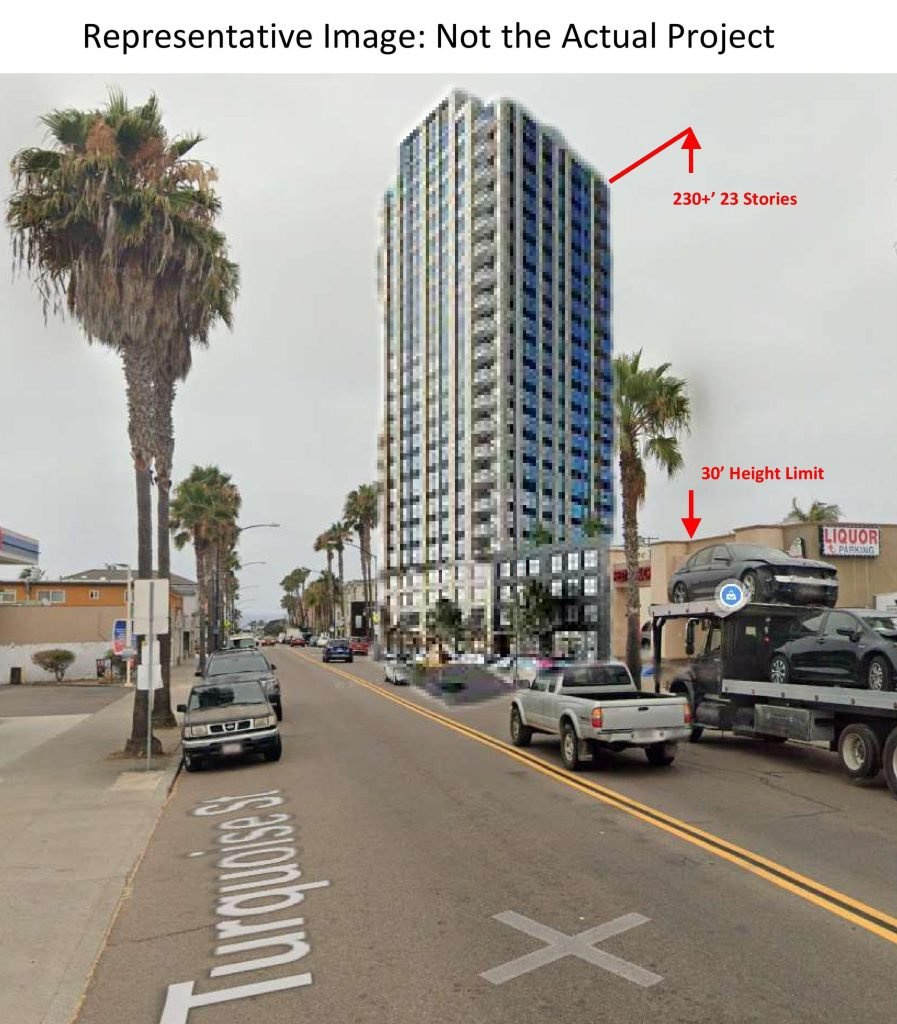
In Part 1 of our conversation (read it here), Bothwell provided an update on one of the hottest San Diego news stories, Project Vela, the proposed 23-story tower in north Pacific Beach that her organization opposes; she also touched on the sale of French Gourmet and the possible need for a constitutional amendment.
Here are highlights from Part 2 of our conversation:
On Senate Bill 92
If passed, State Senator Catherine Blakespear’s SB 92, said Bothwell, would ensure that developers seeking density bonus incentives allocate at least two-thirds of a development’s units for residential housing, as opposed to using the space predominantly for visitor accommodations, as is being proposed by Project Vela developer Kalonymus.
“SB 92 just trues up the density bonus law with the housing accountability act with a requirement of two-thirds residential (not affordable residential) and one-third market-rate commercial units,” Bothwell told me.
If passed, the law will not apply retroactively, meaning it won’t apply to projects like Project Vela that are already in the works. While appreciative of the Senator’s efforts, Bothwell feels the bill doesn’t go far enough.
Specifically, it doesn’t address the height limit or increase the percentage of affordable housing units that developers must build in order to qualify for the incentives. “It does nothing for our height limit predicament, and we don’t think that it does anything more for affordable housing,” Bothwell previously told CBS News.
On the unfair tradeoff
Bothwell insists that the tradeoff is unfair. In the case of Project Vela, developer Kalonymous essentially gets to ignore local zoning regulations and cash-in on highly valuable incentives like waivers and concessions.
In exchange, the out-of-town developer agrees to slightly reduce the rent for five to ten of the 239 units. In reality, who will have the monthly income needed to rent these supposedly affordable units inside this fancy-schmancy tower? Not working- or middle-class folks, that’s for sure.
On fake affordable housing
“On our website (neighborsforabettercalifornia.org), you can see that the amount allowed for the developer to charge for moderate income units is actually above the market rate in Pacific Beach. This does not seem to be real affordable housing,” said Bothwell.
What can be done about it in the future?
“We want the city’s Development Services Department to allocate enough resources to investigate how much it costs to create truly affordable housing. We need to reestablish the housing redevelopment agencies that the state got rid of in 2014, which provided truly affordable housing subsidized by the state,” she said.
A lawsuit, constitutional amendment, statewide initiative, and legislative remedies are all on the table, Bothwell said.
The need for new affordable housing models
Developers tend to regard affordable housing as a money-loser; they prefer building high-rise apartment buildings, which are more profitable than single-family homes. The idea behind the density bonus law was to motivate developers to build affordable housing by letting them bypass local zoning rules that often limit the scope and size – and the profit margins – of a given project. A developer that exploits the state density bonus law is able to build extra units that essentially compensate the developer for losses they incur from the slightly less expensive units that they agree to rent out. Without the revenue from the bonus units, and in particular the higher-up units, affordable housing projects would not be financially viable, claim developers.
Said Bothwell: “We have misaligned incentives for developers” like Kalonymous that “are for-profit companies trying to maximize profit. They don’t have the skill set or motivation to provide affordable housing.”
Developers that don’t want to touch affordable housing unless they get huge incentives and concessions in return don’t need to apologize for being capitalists but maybe aren’t the best fit for the job.
But just because Kalonymous might not be doing it the right way, doesn’t mean it can’t get done. In fact, directly across the street from Bothwell’s office, she notes, is “a local developer who is providing four low-income units in a 44-unit development, which does not break the height limit. We know affordable housing can be developed well in our area without providing the developer such egregious profits. Affordable housing is necessary in all of California’s communities to do this, developers as well as communities need to share the responsibility and cost,” she said.
Consider Rose Creek Village, another controversial development in Pacific Beach that’s been in the San Diego news. The developer may have gotten off on the wrong foot by deceiving the city about its need to build higher than the 30-foot, voter-enacted height limit, but at least the subsidized Rose Creek project is, as Bothwell points out, “providing 60 units of truly affordable housing.”
The Fake Housing Crisis
The late Marin writer Sharon Rushton spoke about what she called California’s “false housing crisis narrative,” a concoction, she claimed, of the Power Players – Big Real Estate, Big Tech, and Big Wall Street investment firms – that sought to expand their investments in residential properties:
“Since 2008 and accelerating in 2016, the Power Players have sought to change land use policy and regulations. They have been successful. Recently enacted housing laws take away local control of residential land use and give it to real estate developers to maximize their return on investment (ROI); raise the value of residential properties via up-zoning (increasing density); reduce the cost of residential construction via deregulation (weakening the California Environmental Quality Act – CEQA and development standards) and lower developer fees; and augment rental income by promoting market-rate housing over affordable housing. Deregulation has included removing democratic public engagement and due process, such as public hearings and environmental analysis. No longer does the local city council, with residents’ input, make decisions. Instead, real estate investors and developers determine where and how much housing growth will occur, with no regard for local conditions, capacity, or adverse impacts
This agenda has been aided and abetted by a finely tuned “False Housing Crisis Narrative,” which includes both a false problem and a false solution. The powerful pro-development forces incorrectly define the housing affordability dilemma by over-inflating the projected population and job growth and, therefore, the number of new housing units needed for that growth.”
For her part, Marcella Bothwell noted that she “just heard from a developer last night at the planning group that a developer is having a hard time finding renters for his units. I think the market forces are beginning to bear fruit. I think the cost of housing is more complex than build, baby, build. It involves multiple aspects, including home loans, interest rates that fluctuate, inflation, monetary supply policy, etc. This simplified argument has not produced more affordable rates for people who want to build equity and create generational wealth.”
Similarly, UCSD economist Richard T. Carson told me that our legislators and planning officials have bought into this “old-school, supply and demand mantra.” San Diego’s not a closed city but competes with Seattle and Austin and San Francisco and other cities for the high earners, who bid up rental and home prices. Reckless building doesn’t change that economic fact, he said.
If San Diego’s housing crisis is overblown or overstated, clearly the affordability crisis is very real.
On Achieving a Balance Between Affordable Housing and Quality of Life
Bothwell said it’s not an either-or situation: We can have affordable housing AND protect our environment and quality of life. “I appreciate the need for affordable housing, especially workforce housing. It doesn’t mean that we have to destroy the coastal communities, eliminate safety standards and wreck environmental protection laws to create affordable housing.”
Editor’s Note: If you want more info about Project Vela, check these articles out and be sure to visit Neighbors for a Better California HERE.
Does San Diego have the power to defeat the tower?
San Diego, watch out for these housing projects. Coming to your neighborhood soon.
Is Project Vela’s ‘candle’ burning out?
Why Project Vela should be opposed
Thank you for supporting independent, San Diego news source S-Reporter







Leave a Reply