
On the heels of the new year, there’s plenty of San Diego news, especially on the affordable housing front, to update you on. Let’s get started.
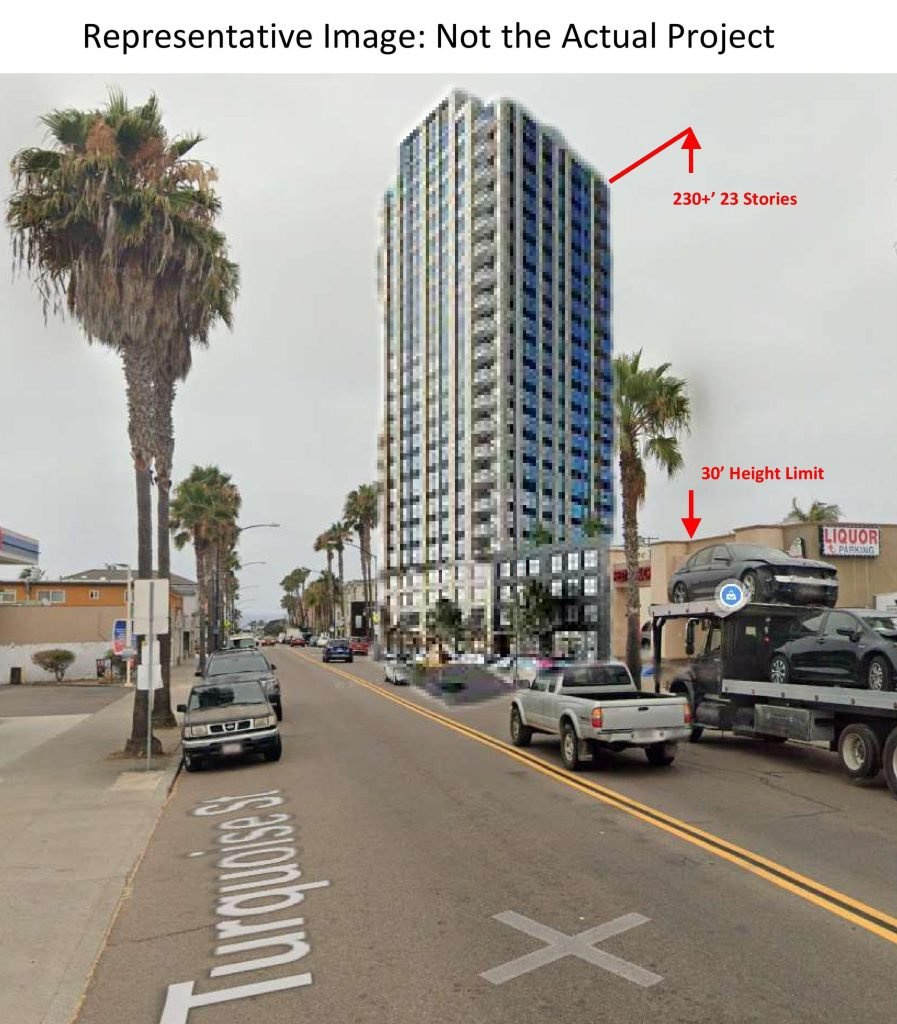
Rose Creek Village in Pacific Beach
Talk about getting off on the wrong foot. The developer of this controversial, highly subsidized, 5-story building in PB reneged on its promise not to exceed the voter-enacted, 30-foot height limit. Council Member Joe LaCava, who represents PB, was super pissed, referring to it as “the most egregious bait-and-switch that I’ve heard in my long private career in housing.”
Nonetheless, the project, which is being subsidized by the taxpayers to the tune of $4 million, is moving forward.
If the developer is allegedly untrustworthy and the development violates the height restriction, then why do business with them?
I think because, even granting those concerns, Rose Creek is seen as an important project. Unlike Project Vela, that critics say masquerades as affordable housing, Rose Creek provides legit affordable housing options for low-income residents, and near transit. The project, which will replace an existing building at 2662 Garnet Ave, is being billed as the first 100 percent affordable housing project in a San Diego beach community; its 60 units are earmarked for low-income people in addition to homeless and veterans. It may be the noble end justifying the means.
Whatever the case, the Rose Creek developer is expected to break ground as early as February or March.
Project Vela
Community activists opposed to a controversial development proposed for north Pacific Beach got some good news when the state clarified that the city of San Diego has the power to deny the development if it has cause to do so.
The ball is now in the city’s court.
Point Loma
Five acres of undeveloped land in Point Loma were sold by the San Diego Housing Commission to a Bay Area developer. Their plan is to build 72 units spread across three buildings, each three stories tall, on a section of land – the lot on the corner of Nimitz and Famosa boulevards – that locals use for off-road biking and feel some attachment to.
According to the UT, rent could be as low as $852 per month for a one-bedroom apartment and well over $3,000 a month for a three-bedroom unit; the exact rent would depend on your income and the number of people in the dwelling, among other factors. Although community opposition—and, in particular, concerns about the development’s impact on protected wetlands—is mounting, it seems to be moving forward.
Don’t mess with Clairemont
After a developer proposed to build ten ADUs, or Accessory Dwelling Units (think granny flat), on a Clairemont property, amid rows of single-family homes, homeowners joined together and sued the developer, SDRE Homebuyers LLC, along with the city.
Of course, on the face of it, it appears that the developer is just exploiting the law on the books. San Diego is apparently the only city in the state that allows developers to build one market-rate ADU for every “affordable” ADU they build. Buy one, get one free.
Danna Givot, vice chair for Neighbors for a Better San Diego, told Fox 5 San Diego that data provided by the San Diego Housing Commission showed that no bonus ADU, as of December, had delivered a truly low-income unit. So, essentially, after allowing out-of-town real estate investors to take ownership of our neighborhoods, we didn’t even get a few affordability crumbs in return. This warrants more attention and investigation.
If the project proceeds, ten units will be built in five, two-story buildings; in addition, the garage will be converted into an ADU and the main home renovated.
A hearing for the lawsuit has been scheduled for May. Shoshoni Ave neighbor Jerry Rapp has launched a website to explain their cause and raise money to fund the lawsuit.
Sweet Seventeen
Clairemont is becoming ADU Central. There’s another, even bigger project on the horizon, also in Clairemont and also featuring developer SDRE (which has offices in Kearny Mesa). The developer’s proposal to add 17 ADUs behind a single-family home in a cul-de-sac with no parking has some neighbors up in arms.
But the construction workers have already arrived.
Another big trend playing out in San Diego is the rise of corporate ownership of our neighborhoods. Real estate development and investment companies are buying up homes like it’s the gold rush.
A new report found that Blackstone owns more than 60 apartment buildings in San Diego County, including Golden Hill. According to one study, average monthly rental prices in a Blackstone neighborhood increased from $1700 to over $2300 over a three-year period. Jordan Ash, of the Private Equity Stakeholder Project, said rent in Blackstone-owned buildings increased as much as 79 percent over three years.
Experts say Blackstone went on a buying spree during the pandemic, taking possession of over 250,000 units across the nation, including some 6,000 units in San Diego.
Learn more here:
Thank you for supporting S-REPORTER, your independent, San Diego news source









Leave a Reply