
A conversation with Marcella Bothwell of Neighbors for a Better California – Part 1 of a 2-part interview
**
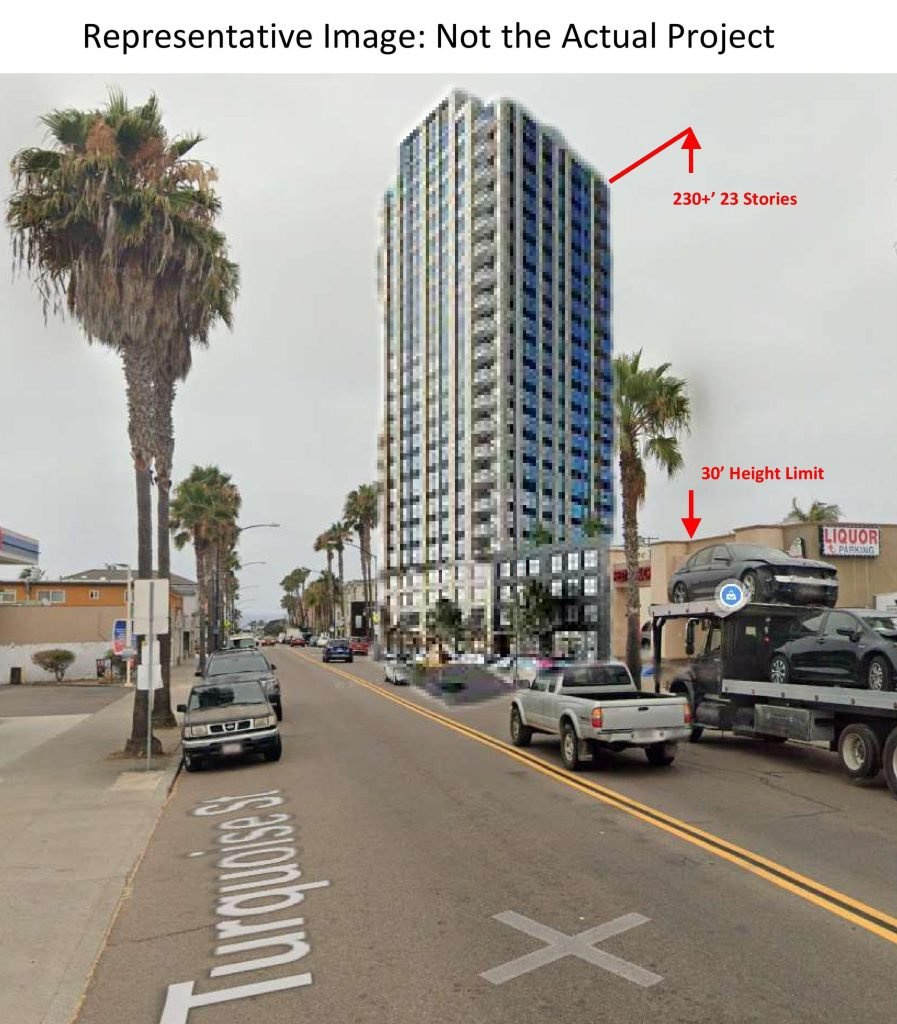
We’re in a waiting period while the city studies the Project Vela proposal in light of a technical guidance letter it received from Sacramento. It was greeted as good news by community activists because it indicated that Mayor Gloria has the authority to deny developer Kalonymus’ ministerial request for a permit that, if approved, would allow a 23-story, 239-foot, high-end tower to be built on Turquoise Street in north Pacific Beach.
For its part, the developer also claimed the state letter was good news, as it confirmed its eligibility for concessions and waivers it’s seeking.
Critics charge that the development doesn’t qualify as residential housing and provides only a pittance of affordable housing in exchange for which the out-of-town developer gets to essentially ignore local zoning regulations.
Among the concessions and waivers for which the developer apparently qualifies is an exemption from San Diego’s voter-approved, 30-foot height limit for coastal construction. Critics worry that the proposed tower, just a few blocks from the beach, would be a fish out of water, impeding the public’s view and engulfing this quiet neighborhood that borders Bird Rock—ultimately, paving the way for the Miami-ization of San Diego’s coast.
The city recently told S-Reporter that it could be several months before there’s a decision.
It was against this backdrop that I chatted with Marcella Bothwell, the founder of Neighbors for a Better California, a nonprofit that the retired surgeon and past president of the Pacific Beach Town Council set up to advocate for sensible housing and development policies at the state level that impact San Diego. Fighting Project Vela, which she believes represents an appalling abuse of state law, is her first order of business.

**
Adam Behar (AB), S-Reporter.com
Marcella Bothwell (MB), Neighbors for a Better California
French Gourmet Sold
Bothwell confirmed that Michael Malecot, the long-time owner of the French Gourmet—on whose property developer Kalonymus seeks to build the 23-story skyscraper known as Project Vela—has received payment by the developer in the account of $6.5 million.
Some have speculated that Malecot has an agreement with the developer that allows him to operate for the next year or until the permit process has been completed. Either way, Bothwell says they have up to 18 months to get it done.
AB: What are the implications of Malecot’s decision to sell? Are you concerned that it could influence the Mayor’s decision – the perception that this ship is sailing?
MB: Frankly, this was not unexpected. Mr. Malecot is at retirement age, and it is reasonable to assume that he would take the highest offer for his family’s benefit. Therefore, we must concentrate our endeavors on the city doing the right thing in denying this permit.
AB: What would you like to see happen?
MB: The current DSD budget allocation needs to be used appropriately to deny permits that are inconsistent with our municipal code and community plan. The city must defend appropriate denial of a permit requested by a developer. (Editor’s note: The San Diego Development Services Department, or DSD, reviews, permits, inspects, and enforces codes for development projects in San Diego.)
AB: Here’s Mayor Gloria himself, let me read this, from a letter he and co-signer Councilmember Joe LaCava sent to the Pacific Beach Planning Group: “Pro-housing cities like San Diego…have long been advocates for creating more affordable housing for San Diegans of all incomes; however, this project does not align with state or city policies aimed at building more affordable housing. We must not allow pro-housing policies to be usurped for purposes that do not serve a public benefit or respond to the state’s affordability crisis.”
AB: Do you know where the city’s at in terms of their information gathering and assessment?
MB: The DSD is done with cycle one reviews and we looked at those. The developer needs to respond to the cycle-one comments. It’s not just the height. We are also still concerned about the base density at 31, which is not consistent with our community plan. To obtain the commercial-based density of 31, our community plan requires a discretionary permit not a ministerial permit. (The Pacific Beach Planning Group is sending an important letter to the city on this matter, which will be posted on the group’s website.)
AB: Ministerial approval allowed by state law may expedite the permitting process like the developers want but it means San Diegans lose local, community input and control.
MB: Sacramento is hundreds of miles away and has no idea of our community needs. Even the city’s DSD doesn’t have an unlimited staff. Planning groups and local citizens are a vital resource for the city and the state, so policymakers can know the real needs of the community. By making everything ministerial, it’s eliminating any local input. It’s frankly a safety concern for our communities.
AB: Can this be changed through state legislation?
MB: Given the composition of the state legislature and voting records by both Democrats and Republicans, changing this ministerial approval process is a heavy lift. It is likely a constitutional amendment will be necessary requiring local municipal codes to be elevated above state regulations in the specific area of land use and housing.
AB: Are you concerned that Gloria is a build, build, build guy and will come down on the side of the developer? How do you in your gut think this will be resolved?
MB: I think this particular development is a black eye to the pro development community and so it will be an embarrassment if this is allowed to go to build with only five low-income units. It’s a sad day that we have to rely on shaming officials to do the right thing for our community.
AB: Are you starting to prepare for the possibility of having to file a lawsuit and raise money for that effort? If there is a lawsuit, on what grounds would it be filed?
MB: Our homepage goes into this very question. Our problem again is we don’t know which way the city is going to rule on the permit.
AB: There was mention that NFABC was weighing whether to join with another party to fund a statewide survey. This would help you find out if Californians support a constitutional amendment to restore citizen rights.
MB: I have invited a board member from Our Neighborhood Voices this Monday to discuss the poll that they did four years ago regarding the California people’s position on local control. They have a constitutional amendment they want to bring forth and we are discussing this further with them on whether to support their initiative process. I have specific questions about the demographics and questions used in the poll and I hope we get good answers. I don’t want to reinvent the wheel.
AB: In the meantime, what do you want interested parties to do?
MB: This process is a developer’s dream. They have one goal and that’s to make money and they have the war chest to wait us out for this permit. The city has said they have 18 months to make a decision on this permit.
AB. That’s a long time.
MB: There will be periods when immediate action is needed and time that we have to just wait. Unfortunately, people’s interest waxes and wanes and the hurry-up-and-wait issue is frustrating.
AB: If waiting means you’re quieter, then you lose momentum and urgency?
MB: That’s why, during this waiting time, we need to maintain pressure with email campaigns and social media post to the Mayor and DSD telling them to do the right thing and carefully evaluate this permit on its merits and then deny it. The mayor should not be afraid to do the right thing for his constituents just because of a potential lawsuit by a developer.
I urge people who care to please email the city representatives (which are on our website) so they know that their constituents are watching this process. Make sure that they know we are the stewards of our community and we do not want high-rise developments along the coast.
AB: And down the road?
MB: The other fight will be with the state and the legislature about local control being returned to the constituents and the taxpayers, but this will be a difficult uphill battle. In the next few weeks, we will be working on a social media campaign directed at state officials and we would love everyone’s support.
Editor’s Note: Keep an eye out early next week for Part 2 of our interview with Marcella Bothwell.






Leave a Reply