
A ruling on NoiseGate, the Gallagher Square noise lawsuit, is tentatively set for Friday.
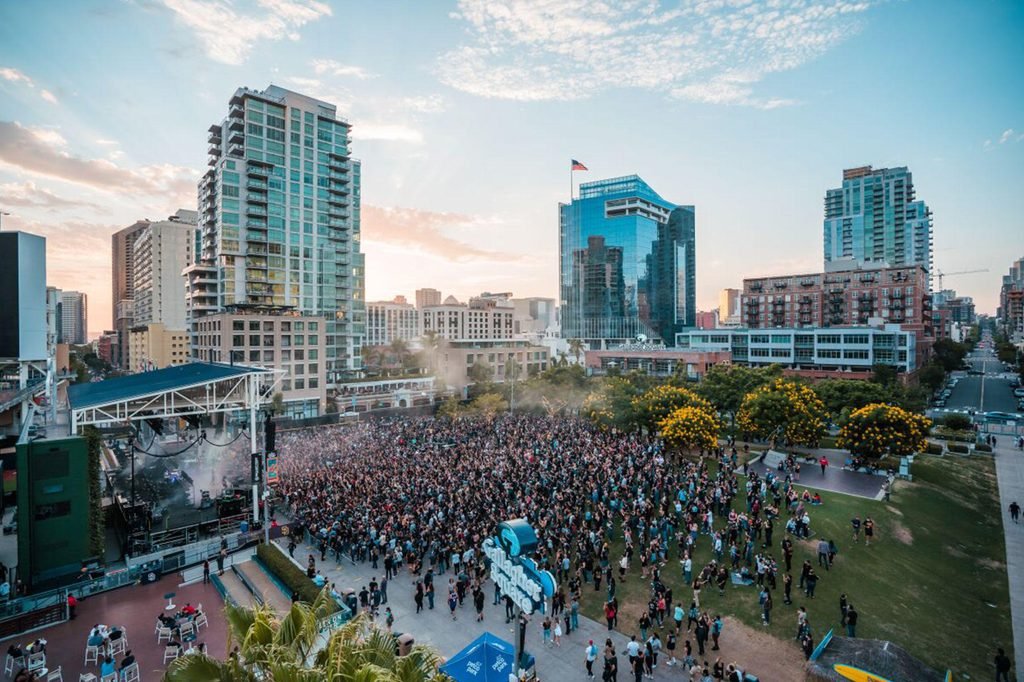
After three years of litigation, including a failed mediation effort in July, San Diego Superior Court Judge Carolyn Caietti could determine Nov. 6th whether the city and the San Diego Padres’ open-air concerts violate municipal sound codes. That’s right, this Friday, we may finally learn who downtown is really for, the people that live there or the people that party there.
The key issue
The lawsuit, brought by the coalition Residents Concerned About Gallagher Square Noise, seeks a writ of mandate compelling the city to enforce its existing noise ordinance and ordering the Padres to reduce outdoor decibel levels.
S-REPORTER spoke with Ron Donoho, editor of The San Diego Sun, who’s done a stellar job covering the Gallagher Square noise lawsuit, and University of San Diego law school professor Mary Jo Wiggins, an expert in land use planning.
The Padres and the city argue that the venue operates lawfully within the Ballpark District as a permitted special event. The homeowners bringing the case insist Item 11, which appears to exempt permitted venues from noise codes, wasn’t kosher.
The smell of backroom politics
Downtown Community Planners Committee Chair Gary Hewitt questioned the city’s assertion that the ordinance was a “clarification” of existing law. Donoho told S-REPORTER: “It seems likely that [Hewitt] is correct that Item 11 is not a clarification, rather, it’s a new blanket exemption from the noise ordinance for any permitted activity. If it stands, and if it is a factor in the Padres/city winning the lawsuit, that smells of some backroom politics.” According to a San Diego Sun story, it was “discovered at the last minute before final city council review,” causing some observers to wonder if it was an effort to sway the court case. In September, Item 11 was approved by the city council.
Possible outcomes
Professor Wiggins walked me through factors Judge Caietti would likely consider. Do the concerts cause homeowners a substantial “private nuisance” – not something they merely whine about but “a substantial (i.e., non-trivial) interference with the neighbors’ use and enjoyment of their land.”? (On social media, there seems to be some disagreement as to whether residents retain the expectation of privacy or surrender it when they move into the ballpark district).
“Essentially, what a typical court has to decide is whether, overall, the concerts cause more harm than good.”
A dismissal is a possibility. Some observers worry it could mean the judge found that Item 11, the municipal code revision, exempted the city. Could entertainment permits now trump city noise ordinances? Wiggins, who didn’t offer any predictions on how the case would be decided, said she doesn’t see Item 11 “completely mooting future nuisance lawsuits altogether.” She said it shouldn’t “directly affect the ability of a private citizen to sue for future nuisances. At the same time, it could give the defendants a decent argument that what they are doing is more reasonable than not,” she said. “So, it isn’t risk-free for the plaintiffs.”
If the judge rules in favor of the residents, it could be because the environmental reviews that the city relied on in 1992 and 1999 – establishing a 95-decibel threshold at Petco Park – could not be applied fairly to Gallagher Square’s open-air venue. When a band performs at Petco, the sound doesn’t carry as far and as loudly into the neighborhood, the reasoning goes, because it’s obstructed by the cement barrier surrounding Petco. By contrast, from Gallagher Square, sound travels unimpeded, straight to residential buildings.
Balancing of interests
A third possible outcome is a compromise injunction that attempts to balance the interests of both parties. Says Wiggins: It could keep the concerts but “command the Padres to actively and timely address the residents’ concerns through specific actions” and include “requirements that the Padres report back to the court on their progress in a timely manner,” she said, noting that an attractive feature of injunctive relief is that it “provides a judge with the power to fashion relief that balances the competing interests in a fair and equitable manner.”
No resolution
A fourth option is it doesn’t get resolved Friday – instead, the judge issues a preliminary ruling. “It is not unusual in cases of this sort,” noted Wiggins. The judge often uses it to signal to the parties what the judge believes the relative strengths are of each side’s case. “It can help spur a resolution without further need for litigation,” she said.
NoiseGate: The Social Media Wars
The battle in the courtroom is mirrored on social media, between those who embrace urban energy and those preferring residential peace. “Imagine getting upset that you get to hear a free concert every now and then,” posted commenter Chris Casao. “That would literally sell me on the property. Free music? Heck yeah!” noted Aleksandra Dennis. Markel Tumlin countered: “Every now and then? It says twelve high profile concerts coming just in October. They have them all the time, not just every now and then.” Others opined that, if you move downtown, the noise comes with the territory.
Donoho told S-REPORTER: “If you just read a social media post and then declare, ‘These people should have known it’s noisy around a downtown ballpark,’ you’re missing the whole story. The big picture also includes the Padres’ ability to be in a profit-sharing deal with the city, which has regulatory oversight over the project.”
Editor’s Note: READ “FORMER SAN DIEGO PADRE GETS TWO LIFE SENTENCES”






Leave a Reply