His national profile is increasing while his local profile is diminished
Mayor Todd Gloria’s refusal to protect San Diego’s arts and culture industry from drastic budget cuts has earned him the ire of many San Diegans.
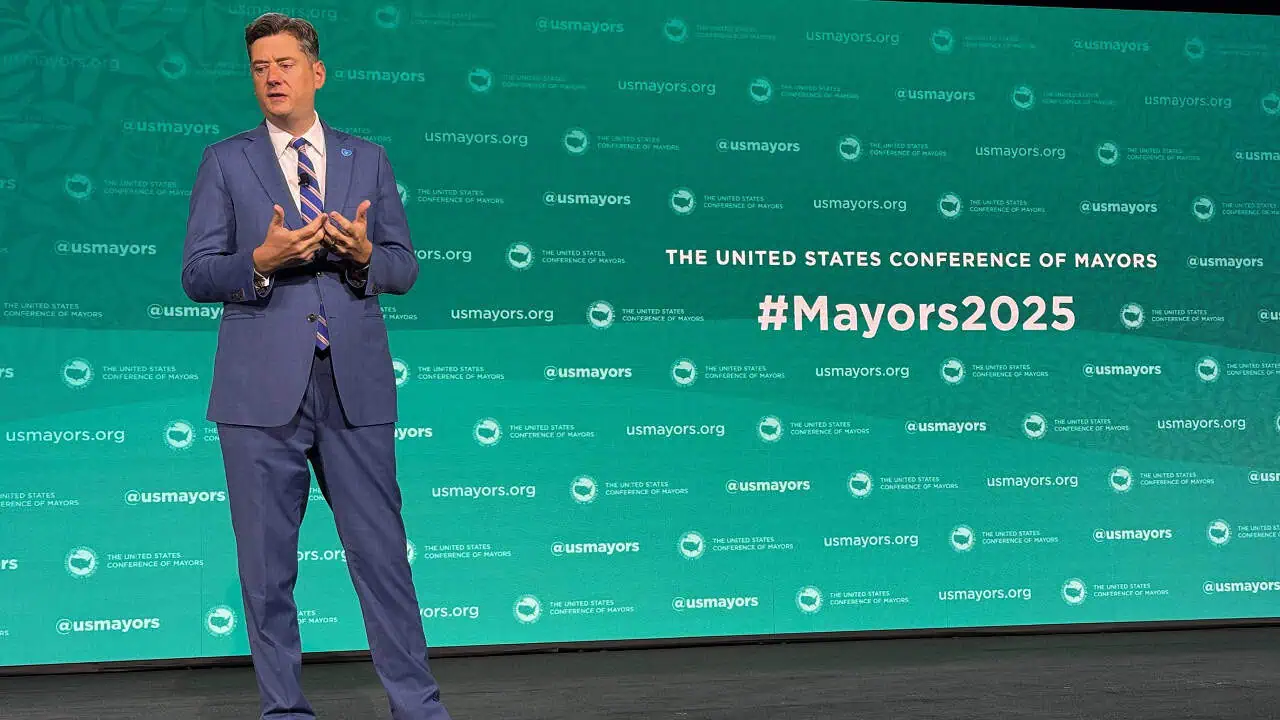
But, while the lame-duck mayor’s reputation may be diminishing locally, his national profile will receive a boost today when the United States Conference of Mayors is expected to inaugurate Gloria as president at its 94th Annual Meeting.
Gloria’s position on arts and culture is very different from that of David Holt, the USCM president he’ll be replacing. Holt is the mayor of Oklahoma City, Oklahoma, which may not scream arts and culture. And yet, Mayor Holt has taken a different tact, arguing that cultural investments are fundamental to economic recovery and community vitality. He insists arts isn’t a frivolous, optional luxury item that can simply be cut when times get tough. Under Holt’s leadership, Oklahoma City has been ranked as one of the top cities in the U.S. for public art. He has consistently advocated for maintaining public art funding even during lean budget cycles.
Holt posted on Facebook last month after being informed that Oklahoma City was rated #2 in U.S. News and World Report’s rating of the Best Big Cities to Live in the U.S. (with populations over 600,000). “This ranking would have been inconceivable in the 1980s and 1990s, but it reflects an intentional strategy we’ve deployed ever since those challenging years,” wrote Holt on Facebook.
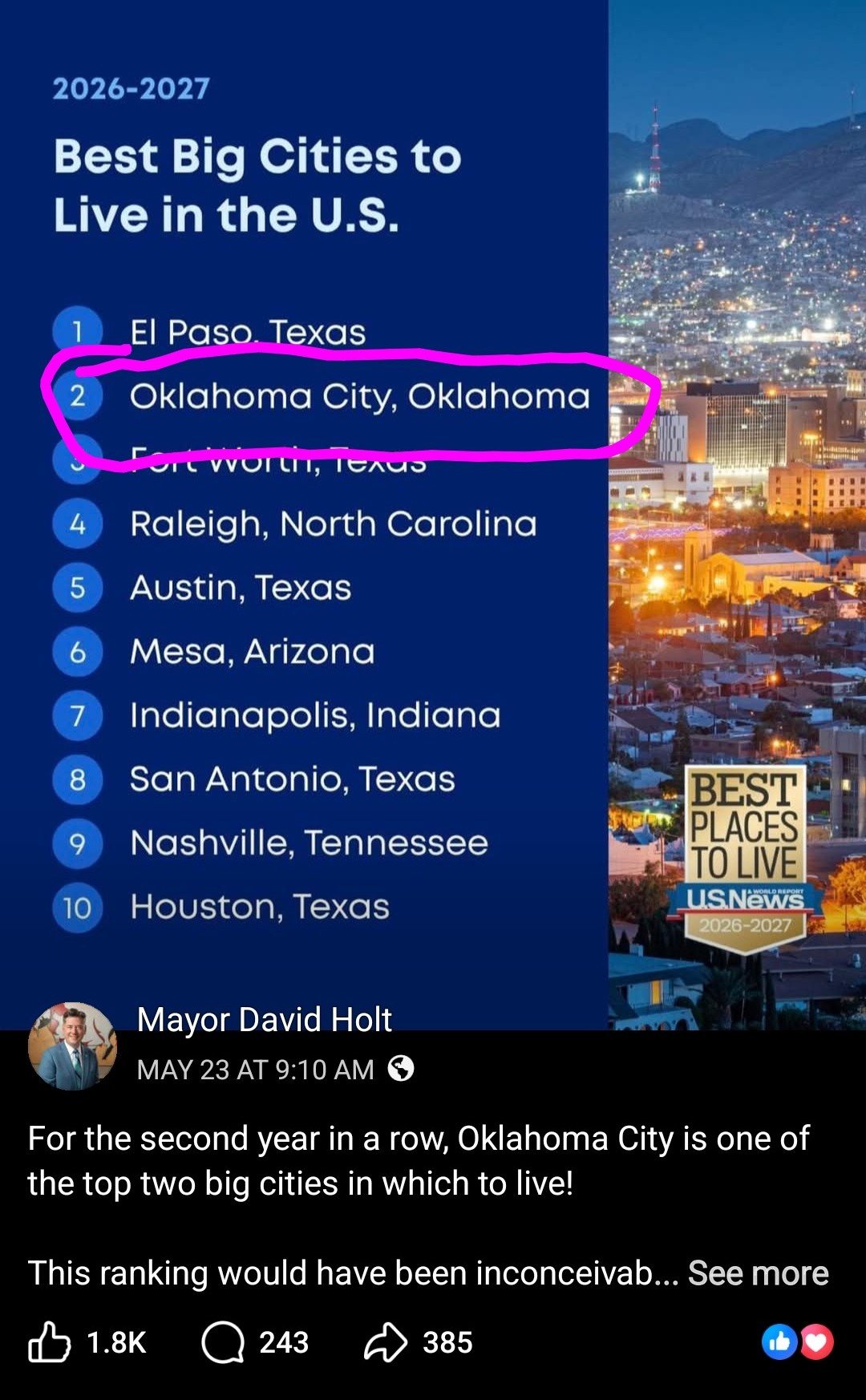
Cities were scored based on cost of living, value, commute times, and local amenities. Here’s what the editors like about Oklahoma City: “Its cultural richness, incredibly low unemployment, and a strong value index offering affordable family homes.” The turnaround didn’t happen overnight. Holt noted that, over 30 years, “our residents have passed 15 votes totaling $10 billion of investment in our quality of life. Now, we’re enjoying what happens when you invest in your city.”
The contrast between outgoing president Holt and incoming president Gloria is striking. In 2023, the USCM honored Holt with the National Award for Local Arts Leadership for his advocacy and protection of the arts. For his part, Mayor Gloria insists arts and culture is not an essential component of our city. San Diego is the eighth largest city in the nation by population, while Oklahoma City is the 20th largest city. That Oklahoma City is surpassing San Diego in arts and culture is not surprising. Throughout San Diego’s history, critics have said there was something provincial about San Diego. Right when we were beginning to shed that image (San Diego was recognized as the design capital of the world in 2024), Gloria’s austerity has taken us back to our philistine past. San Diego can once again be the small Midwestern city that it was perhaps destined to be.
Tom Cochran, USCM’s CEO and executive director, who will be working closely with Gloria, is another pro-art guy. He said that mayors like Holt “understand the inherent value of the arts to bring people together, promote cultural understanding, and make cities safer places to live, work and play.” (Art makes us safer? Who knew. Maybe that’s how arts advocates get to Gloria – not through art = revenue but art = safety.)
Like most cities, revenues have slowed in Oklahoma City. Ultimately, for the fiscal year 2026–2027 budget, the city council adopted a very modest, across-the-board cut of 2.4% for all non-safety departments. Still, Holt continues to position arts investment as a non-negotiable “down payment” on the city’s future growth.
It should be pointed out, in fairness, that in Oklahoma City, the arts and culture industry benefits from the voter-enacted MAPS 4 Initiative—an 8-year penny sales tax program generating roughly $1.07 billion. Mayor Gloria may bemoan the fact that San Diego voters defeated Measure E in Nov. 2024, which would have given Gloria another $400 million in general fund revenue. But that begs the question: one reason voters rejected the measure in the first place was because they didn’t trust the city’s fiscal management—so it comes back to Gloria either way. Also, Measure E was for infrastructure and “core needs” and he’s already said arts and culture isn’t that.
All of this leaves me wondering where those “coastal elites” went. They’re not acting very elite-ish, are they? What mayors want these days, especially Democratic mayors, is to avoid being seen as permissive. They want to be the other p-word, pragmatic, and put public safety above all other needs. They hope it shields them from soft-on-crime attacks by their opponents (It won’t).
Gloria’s using the budget process to define himself as a tough-love mayor, the fiscally responsible adult in the room, willing to make the artists cry. The resistance he is encountering helps establish his bona fides. That’s partly what makes it so infuriating—he has other options. He doesn’t have to be the austerity mayor; he’s choosing to be. It’s a calculated, political choice. The fight seems to be working for him. Since he’s a lame duck, he has little incentive to compromise.
Do you think the mayor’s proposed cut to arts and culture is largely political or is Gloria doing what he believes is the right thing for San Diego?
Do you think he will ultimately restore the nearly $12 million in funding? The clock is ticking.
Key Dates;
June 5, 2026: Final Budget Review Committee hearing.
The final opportunity for public input on Mayor Gloria’s proposed FY 2027 budget is June 9, 2026, when the City Council will hold a final budget hearing and vote.
This is the second piece in a two-part series. Read the first piece here.






Leave a Reply